
One of the most significant challenges for girls at school is menstruation. Girls are usually unable to attend school when on their period. Many still don’t have access to menstrual products and even when they have menstrual products a lack of private change areas makes it difficult for the girls.
And generally menstruation is a subject that is fraught with misunderstanding and even taboo. This negatively affects the girls self-confidence and performance in school. So its critical that the local community supports the girls in any Menstrual programme.
Added to this is the issue of sustainability of supply of menstrual products in remote areas of Arica. In the past we have attempted to solve this problem with Cups and Manufactured products. These have been either difficult for girls to use or too expensive.
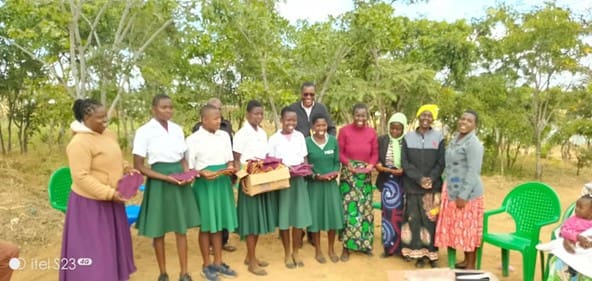
This year we have, by building capacity in Mothers Groups and the support of the District Gender Office in Mchini been able to establish a programme for the manufacturer of reusable, washable pads at Mikuyu, Madanjala and Mankhaka Secondary Schools.

Materials for these pads including cotton wool, thin plastic sheets and buttons are readily available in Malawi and then sewn together by the Mothers Groups.
Hundreds of Pads were distributed to the 3 schools last term.
Comments from the girls has been that the Programme has been very helpful in emergencies and enables them to go to school even when they are on their period. The programme also saves the girls money in the procurement of alternative Menstrual product. For the Schoools, the impact has been lower levels of absenteeism.
Following the initial production of pads, Malawi Schools Trust has now also donated sewing machines to each of the 3 schools. These machines are dedicated toward the production of menstrual pads but are also used by one of the schools to make school uniforms for girls.
In addition, we are building exchange rooms in each school to provide privacy, supplies and wash facilities for the girls during their periods. These rooms are small, basic, brick structures for the girls to use, but are so crucial in providing much needed privacy.
Through provision of menstrual products, as well as support from the mothers groups and female teachers, this intervention gives girls an opportunity to discuss a broad range of SRHE issues including early marriage, pregnancy and sexual health.
It has taken a few months for the Mothers Groups to learn how to make the pads but so far they have made over 150 Pads.
With the success of this project so far, the Mothers Groups have committed to making sure that all girls at the 3 schools get 2 Pads each year. The cost of the menstrual pad materials for each school is £300 per year, a cost of £2 per girl per year, so we are hopeful that this will be a sustainable, community-based solution for the long term.